Showing posts with label Extrema Ratio Giant Mamba. Show all posts

Tuesday, 9 March 2021

Bush crafting with the Giant Mamba?

Tactical Bushcraft???? Why not?

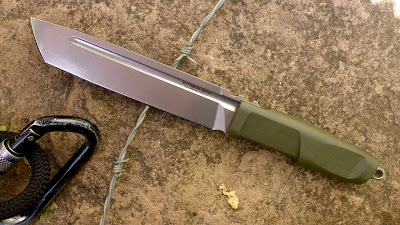
Why not? One can "bushcraft" with just about any knife if you know what you are doing and what the knife is capable of. Don't let any tell you otherwise because it is BS. The Giant Mamba can handle the pace make no mistake about it. Clean lines, super strong blade, rapid drawing scabbard action. 


Chose the handle and scabbard option color scheme for the job at hand.
My only beef is why carry the milling of the fuller into the grip region? Makes no sense to me and the amount it would lighten the knife is of no  consequence.

BCT

Saturday, 4 July 2020

Design characteristics of 2 similar but distinct Extrema Ratio Models: T4000S and Giant Mamba

Design characteristics of 2 similar but distinct Extrema Ratio Models: T4000S and Giant Mamba


Similar shaped profiles as seen viewed side on, the Extrema Ratio Giant Mamba and the T4000S make for an interesting comparison.
 At first glance these two knife models look similar, the similar handles of Forprene moulded around the Extrema Ratio signature ergonomic grip. Some slight modifications can be seen on the handle of the new (for 2020) Giant Mamba, mid way the angle of the moulding is a little more steeper than that of the original design as seen on the T4000S (right hand side image).


The blade width of the Extrema Ratio T4000S is slightly wider than that of the Giant Mamba and as shown below, slightly longer too. The main differences are the following:

1) Blade thickness is much greater in the Giant Mamba, a full 6mm to almost the tip, compared to a 6mm tang thickness, quickly narrowing to a 4mm spine thickness after the hilt region, tapering spine starting to thin to a point from approximately 40mm back from the tip on the T4000S.

2) Both blades feature a double sided fuller/blood groove.

3) The T4000S is a lighter and thinner blade capable of cutting more effortlessly through hard thick substances, simply due to less "forcing" due to it's thinner blade profile

4) The tip of the T4000S is more acute and "pointy" than that of the Giant Mamba but of course also thinner.

The difference in spine thickness is clearly evident between these 2 models. No gimping is present on the T4000S however, the spine is slightly raised above the Forprene material (this avoids unnecessary damage to the handle should the knife be struck here with a blunt object).


The method of securing the handles are very different. The Giant Mamba does not use a centre handle bolt but a non-captive nut placed within the tang which accepts a pommel bolt. This nut can be lost if the handle is carelessly removed for cleaning unless the user modifies the nut (loctite, or some other non-permanent adhesive to prevent accidental loss). If this nut is lost then it would be very difficult to attach the handle again, not impossible but very difficult. This is a custom made nut and can not be found in one's local hardware store, nor can it be easily field modified from other parts. Unlike losing the bolt from the standard handle assembly, one simply ties some cord through the pommel lanyard hole and the handle can be securely attached. So owners of  the Giant Mamba take note: Do not disassemble your handle in the field unless you take precautions not to lose this small nut (I  put adhesive tape on mine and it works just fine to retain the nut. One could use a semi-permanent Loctite as well).


The main edge of the Giant Mamba is almost straight whereas the main cutting edge of the T4000S has a slight curvature to it. Both have a hand ground convex edge and both are easily kept sharp.


The tips are very different with the Giant Mamba sporting a much steeper angle and slightly more pronounced curvature compared to the T4000S. I think in practical terms both sets of fullers do little to really lighten these blades.


The handle of the Giant Mamba covers more of the tang than that of the T4000S, this makes the handle less likely to suffer damage due to greater supporting material, although the rigidity of the particular Forprene formulation (shore hardness) is quite adequate.


Conclusions

The T4000S is better suited (if chosen) for "outdoors" work than the Giant Mamba due to its thinner blade construction and slightly deeper profile. There is no generalist task I can not do with this model in the outdoors.

The Giant Mamba is better suited to a more "abusive" environment such as a military/tactical arena as there is little chance of tip breakage on this model and the overall blade is clearly of a stouter construction. As I have shown one can certainly perform outdoor tasks with this knife, albeit it is not an outdoor knife by any means however due to it's relatively short length, it can be manipulated with some dexterity for camping/outdoor tasks (again as above, if chosen to do so).


BCT

Wednesday, 3 June 2020

Can the Extrema Ratio Giant Mamba make the grade of "Survival Knife"

Can the Extrema Ratio Giant Mamba make the grade of "Survival Knife"?


To answer the above question, we have to have a definition of what is expected of a knife in order to satisfy this "survival" thing. I've already made that definition in previous blogs here, so I'm not going to repeat it since I've written extensively about it.
Provided one has the knowledge in order to facilitate theirs or others survival chances, which is ones "primary survival tool" ie a cool brain, then having dependable equipment with you: which maybe the right clothing; proper shelter/tent; medical equipment; drinking water and or food, maybe your best survival tools. 

A knife may not be necessary but would not go astray under certain situations. For example: where any cutting of objects is required (food preparation-not totally necessary but things can go a lot smoother and be less stressful with one); cutting vines to extract water; gutting animals; signalling for help by using a reflective blade surface to attract the attention of those in the distance, too far to yell at or whistle; the list goes on. However, the impractical use of a "Survival knife" and often romanticised : such as strapping it to a stick in order to fend off a charging Grizzly bear or Lion; defending oneself against hostile humans; smashing through concrete walls to escape your captors; killing big poisonous snakes etc., are far less likely scenarios. Where did I get those scenarios from? YouTube of course, which is overflowing with experts on this subject, apparently. Sorry if I sound sarcastic, I meant to sound sarcastic! I want to market the "survival jacket": Radiation proof, waterproof (of course, it goes without saying); gas proof; bullet proof (small arms only-to keep it light enough) and folds up into my back pocket!

But seriously, where does one need a "survival knife"? Firstly, such a knife should be just as reliable as the tent you plan to shelter in; the clothing upon your back; your backpack and the boots and or shoes you are wearing. I came across trekking in the Himalayas once a guy (a foreigner/tourist) whose boot soles (one of them) had come unglued quite some days away in any direction from buying new boots. He had fashioned with climbing tapes and gaffer tape (where he obtained the gaffer tape I have no idea)- but that was resourceful; a makeshift binding which sort of held the sole to the boot just so he could walk over such rough terrain. Chances of picking up another pair of boots if they fail, not likely in such a situation. I never found out the reason for the failure but at least he was able to improvise and get mobile.

With clothing, you can usually do this (improvise), even fashion some "sunglasses" from a bit of plastic or cardboard with slits cut into them. (though better to carry 2 pairs at high altitude, I did this once and while I never needed my second pair, they did come in handy for someone who had their only pair broken (an experienced ice climber- yes it can happen to anyone and we must always check ourselves). When I was about twenty- boy that was along time ago LOL, I couldn't afford a Gortex jacket like some of my uni counterparts (they were older than me actually- and had good part time jobs); I walked with a metre and a half of waterproof canvas (synthetic) which came from a company my dad was hauling goods for at one point. A straight cut in the middle and yeah (I hadn't seen it at the time) a RAMBO poncho! It sort of worked but if that killer rainstorm we got caught in once, didn't happen in the Summer (it was warm rain) I may have become a liability for not going into the wilds with the proper gear.

Now a knife of some sort is a little different because it may be impossible to repair in the field and or be rendered unsafe to use or dangerous to use in the worst case scenario. Or if you lose one then it maybe impossible to get/make  another. 

However, something as simple as loosing a scabbard: it got accidentally dropped into a fast flowing river, GONE! If it is not possible to make a makeshift scabbard then carrying an open/unprotected blade might increase your chances of getting injured at some point. Of course this can be avoided by keeping your knife scabbard strapped to your belt ALL THE TIME and pocket knives with lanyard holes are better than ones that don't have them because you can secure that knife to yourself before dropping it into a bottomless pit! That also means a lanyard hole on the fixed blade knife of choice as well. No lanyard hole, no "survival knife" or no way to securely tie a cord to the knife, no "survival knife" even if it's a knife around your neck. 

That brings me to the point of "neck knives". I own them and NEVER carry them around my neck. It's a great way to stab yourself and or become a liability. I think they can be a great and useful knife, however not around your neck. This trend and it is a trend, comes from all of these, yes you guessed it, YouTube videos showing people with neck knives defending themselves against would be attackers etc. Have I ever taken a "neck knife" into remote areas? No. Better to take a reliable folder and a medium to large fixed blade, or a reliable multitool and a medium to large (large I mean up to 7") fixed blade, or a multitool and a machete if in the tropics. Why a multitool? Well unless you are naked, then you will probably have stuff with you, on you that a multitool can be an invaluable piece of equipment to have in order to make repairs, service devices such as fishing gear/rifles etc.


Does a "survival knife" need a strong thick tip? No it doesn't. It can't hurt but it isn't totally necessary if one treats their gear with respect. The Giant Mamba has a tip which comes close to that of the Extrema Ratio ONTOS. So where would such a tip be useful? Well, I'd say on long remote coastal hikes where you might find yourself prying apart wild food stuffs (easy to find in Australia) or prying Abalone off the rocks. Busting or prying apart (I hate to say pallets washed up on beaches for fire wood-make sure it's untreated wood!). A thick tip usually means a thick spine and this could be good cracking open the shells of crabs and lobsters and coconuts. 

Sure, rocks can also work. A thick tip can come in use when working with coconuts (if of course you aren't carrying a machete/parang or the like being more suited to the task at hand). Prying open bits of tree trunk looking for grubs to use as fish or bird bait. Using that thickened tip to twist a divot for a fire bow drill (last resort for light a fire in my book-just too much effort). Going through joints of meat, no chance the tip will break. What about skinning with such a knife? Well that depends upon what technique one is used to. For me, I like to start with several cuts but do the main job with my hands as there is zero chance of damaging the skin from an accidental nick, so from this perspective I'm not at a total loss if I don't use a dedicated hunting knife, although, of course a dedicated hunting knife will be more useful for such work and certain hunting knife designs make excellent "survival knives" and "camping knives" IMHO.

I probably wouldn't take this model on remote trips in montane regions but more likely tropical and or coastal areas and as I just said above, I'd prefer to take a hunting knife hunting. Been there done that with various non hunting knives (just to test this out)  and it can be done but is/was a real pain. Talking of tropical, I like the idea of having a western styled or modified Tanto because one can usefully affix the knife to a pole of some sort in order to cut coconuts out of trees. Sure you can climb the tree but it could be risky if you're not used to it.

So yeah, depends upon your skill level with any particular blade but I wouldn't fret too much if this was the only blade I had with me on an uninhabited island!


What are the advantages Vs disadvantages of not having any guards?

 Advantages of no guard  Disadvantages of no guard/s
 Given knife will be slightly lighter in construction. Possible to bang up ones fingers during cutting or chopping against
flat surfaces. 
 Easy to place index finger or thumb atop of spine for better blade control during fine tasks. Can not wrap fingers around guard/s in order to obtain a more secure grip of the knife.
 Usually but not always better comfort and can not chafe hands if not present, especially if hands are wet. lack of Guard/s can't offer any light/slight protection against fish spines.
 Less likely to get caught up on things- knife handle more finger friendly. Guards can be used to help secure a blade for many purposes (one NOT being making a spear!)
 I don't believe guards really stop ones hands from slipping accidentally onto the blade. I've never encountered this  on any non guarded knife I own.Converse argument, the guards can prevent ones fingers/hand slipping onto the blade. 
 You can't have a Modified Tanto with a guard, otherwise it wouldn't be a Tanto or Wakizashi (for design only) Handle material could be damaged?
 Doesn't look so "Military" That's the disadvantage!


BTW I measured with some accuracy the depth of the Fullers on this Giant Mamba blade and it is approximately 0.7mm on each side, not a huge removal of steel, maybe just a few grams in total.

Now remember, there is no such thing as a "universal knife" just like there is no such thing as a surfboard good for all conditions and this follows that there is no such thing as a universal survival knife. Like I said, take the appropriate tool for the trip/job.


Extrema Ratio Giant Mamba in the wilds!


Saturday, 30 May 2020

EXTREMA RATIO GIANT MAMBA

 Newly released in 2020 by Extrema Ratio Italy, the 

GIANT MAMBA*.

A Quick Preview and first impressions by BCT.


The Giant Mamba is a heavy duty use, fixed blade of a 1/4" thickness (6.3mm) and 6.42" long (163mm).  
The overall blade design is that of a modified Tanto.

 Made in Italy Extrema Ratio Giant Mamba


Great classic blade shape
 The Extrema Ratio Giant Mamba 

The Extrema Ratio Giant Mamba is a knife of practical size, easy to wear with a versatile and secure carry system and a robust blade and handle design.

The Giant Mamba features a hefty spine thickness, which allows for placement of "extra" hand pressure should the occasion arise and complete confidence regarding tip and blade strength during penetration and or twisting/levering movements***.

Easily split wood if need be


As always, a knife is only as good as it's edge. We see an excellent edge finish enabling great cutting ability. The Giant Mamba is listed as a multi-purpose heavy duty field knife. Based upon my 35 years plus field experience I see no reason to doubt this company statement.

"Kore wa doko no naifu desuka"?
"Sore wa Itaria no naifu desu"!


That's right, Made in Italy!


The Steel

I'm a big fan of modified Tanto blades and especially those from Extrema Ratio.
Firstly, it's just a very easy blade design to maintain the edge.

Extrema Ratio use Austrian made (from BöhlerN690 martensitic stainless tool steel. This cobalt and vanadium enriched stainless steel can be heat treated to achieve great hardness (in this case HRC 58) yielding excellent abrasion resistance with great knife edge retention. The smooth surface finishes offered by Extrema Ratio help to achieve maximum corrosion resistance with N690 and also having a hardness of HRC 58 allows for adequate percentages of Chromium to remain in solid solution to aid corrosion resistance. (Böhler, pers. comm. 2013).

I can safely say that with almost ten years experience of using knife blades made with N690, this is an excellent quality hardwearing stainless tool steel for outdoor knife manufacture.
 
Extrema Ratio knives are fully manufactured in Italy (the only exception is the N690 steel obtained from Austria as mentioned above).


Shown here is the chemical composition of N690 Cobalt steel as stated by the raw material manufacturer Böhler
(Image courtesy of Böhler)

Blade finishes
There are two blade finishes available for the Extrema Ratio Giant Mamba: Stone washed and Mil-C- Spec (13924) black oxide coated zero reflective blade surface finish. The black Mil Spec coating prevents reflections from the blade and is hard wearing. 

The highly polished  stone washed surfaces such as in the finish by Extrema Ratio, satisfy a good surface treatment (un coated) to maximise corrosion resistance for N690 stainless alloy and provides a totally food safe surface finish, which can easily be kept clean.


Ranger Green against  Alpine vegetation

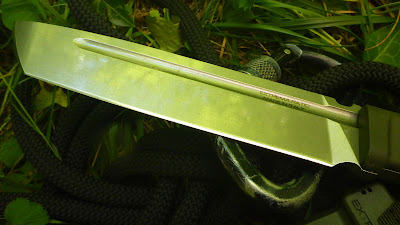
Whilst not a "mirror finish", their stone washing abrasive is such that a very smooth finish is obtained (see above images).


The blade profile is a full flat grind and the edges, like all Extrema Ratio products, professionally hand ground. (Convex edge)
The edges have been finished to a near mirror polish. My experience with Extrema Ratio knives is that they go to a lot of trouble to put a very nice convex edge upon their blades. No ugly grind marks are present.

The above image shows a view of the Giant Mamba's tip. What a beefy tip, and only adds confidence to what Extrema Ratio say about intended "heavy duty use". 


                     The Giant Mamba features a very strong yet versatile tip (see cutting examples below)

You might be thinking such a knife must weigh a tonne but it doesn't, thanks to the very practical length of approximately 6.42 inches/163mm and 2 side fullers on the 1/4"/6mm spine; one ends up with a weight of around 289 grams/10.2Oz. and only 433grams/15.3Oz. combined knife and scabbard weight.

The Giant Mamba is the much bigger (and more robust by design) version of the current Mamba, light weight backup knife line.


Ranger green version seen under light shade


Ranger green version seen in full sunlight (pine and mixed alpine vegetation)


GIANT MAMBA  FULL TANG CONSTRUCTION

Don't underestimate the capacity of the Extrema Ratio Giant Mamba's 6  inch blade, it's a solid tool, thanks to its clean lines and thick spine and big wide 6mm/1/4" thickness full tang.


Sturdy symmetrical tang. As a "modified Tanto", this blade therefore does not possess a guard.


Camouflage


The Extrema Ratio Giant Mamba is available in several handle and matching scabbard and leg retention band colours to help blend with numerous environmental terrains. Shown below is the "Ranger Green" version of handle and scabbard.


                   For example: Knife only (shown in Ranger green).

Ranger Green colouration


The following image shows the same model against vegetation. Knife is inserted in scabbard. Imaging conditions: 1 metre distance from viewer to knife, full late afternoon sun. Excellent blending for green grassy backgrounds.


                            Ranger Green
Giant Mamba (Ranger Green) Against deciduous forest semi shade lighting, distance to viewer 3m

Desert colouration (scabbard is also Desert colour) Full sun.

Desert
Desert


HCS (Hybrid Coyote Sage): This is as the name implies a hybrid color based upon Coyote and Sage, this is a new color of the Italian Special Forces. This color is said to be good for arid regions and behaves differently under different lighting conditions.

(If you've seen my videos on the Extrema Ratio Task J then you will have already seen the HCS colour on handle of the TASK J I own).

Bottom two images shot in the full sun

HCS (Hybrid Coyote Sage)

HCS

HCS
HCS against dry grass/reeds (light shade)


Wolf Grey colouration
Lighting conditions: Limestone rock background, full sunny day, bright shade.


Shown in the above image (medium shade against grey limestone rock face) Giant Mamba with Wolf Grey handle option (accompanying Wolf Grey scabbard, not shown). The below image shows the same knife (also against a grey limestone) in bright shade during full daylight.


and all Black Mil Spec version (not shown-see here).


The Giant Mamba has a versatile blade shape. The modified Tanto allows easy sharpening.

                              
                                         An almost straight lower edge makes for easy field maintenance.


The Scabbard System (Ranger Green version reviewed here)


The thing about Extrema Ratio, is that not only do they make great knives, they don't stop at the knife. Their scabbard designs are very well thought out and provide safe and numerous mounting options within the M.O.L.L.E system, plus more (for the creative or even those who do not use M.O.L.L.E packs/vests). 

In the the case of the Extrema Ratio Giant Mamba, the high impact nylon scabbard is open ended so no material can accumulate within the scabbard, such as mud, sand, water etc. The front and back venting also allows water and mud to freely drain fro these areas and hence these substances should not impede the release of the knife from this scabbard. Long term carry in high humidity regions and or long treks where ones knife may be partially submerged, this scabbard will allow for rapid drying and least chance of corrosion setting in. The Giant Mamba can be carried mounted handle down as the knife is held in very securely, yet able to be release effortlessly via one finger/thumb on the "trigger" lever.

Likewise the deployment of the Extrema Ratio Giant Mamba can easily be fast (but very secure) due to the innovative scabbard design featuring a one touch trigger release system.

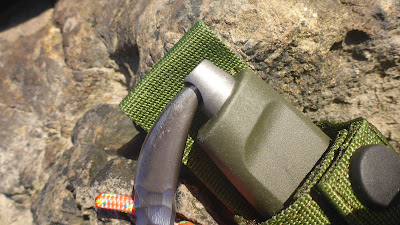
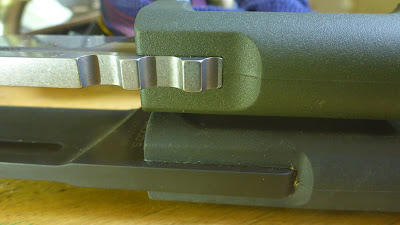
Side view of "Trigger lever" showing the bulge which fits into one of the finger gimping recesses. 
The trigger release can be supplied in either left or right handed release. The lever itself is held in place with two steel pins. One pin for it to pivot around and the other as a stop pin.

To release the knife, the tigger is moved towards the knife
Knife removal is very easy, it can be affected by one hand and yet the knife is held safely and securely. The upper gimping has a double function, as it provides the "notch" to where the locking lever engages. (Note if the handle is removed from the knife itself, then the knife will not remain locked in the scabbard. The handle needs to be attached to the knife in order for the locking system to function correctly).


High impact Nylon scabbard features a one finger/thumb "lever mechanism" to engage the knife safely. 


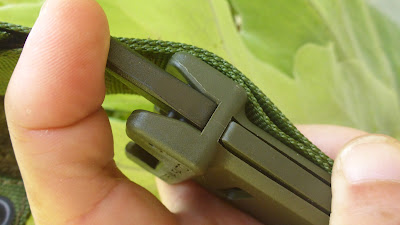
To keep the knife held in a vertical position whilst on a belt, a double press stud closure is provided, which can be adjusted for left or right handed operation via reversing the velcro strap.


Construction Materials
The scabbard is made from High Impact Grade Nylon. "Impact" is a specific grade of Nylon which has extreme resistance to impact forces as the name suggests. It is a different type of Nylon usually designated "Nylon 6 Impact Grade"
To achieve these "high Impact" specifications, filler materials are used in the composition of this thermoplastic polymer.

The scabbard  can simply be "hosed down" should it be contaminated in any way as there is nothing to rot or grow fungus on (eg Tropical environs), this can be done with the knife still inserted due to ample sites of drainage.

The scabbard construction also employs Nylon webbing, Velcro, elastic webbing and a high friction rubber band as part of the leg loop.


In the above image, my thumb indicates the high friction rubber banding on the leg loop.


Excellent neat stitching is apparent on all of the webbing.(below images)


Fully adjustable Velcro attachment on the leg loop. (above image) attaches at the base of the High Impact Nylon scabbard. In order to remove the M.O.L.L.E  (Modular Lightweight Load carrying Equipment)  strap, the leg loop must first be removed.


There is also a belt loop for waist carry (see 2 images above) and another Molle loop at the top of this webbing.


                            Rubber insert prevents "blade rattle"


Carry options for the scabbard are the following:

The high impact nylon sheath is versatile and can be mounted on the M.O.L.L.E. system of a tactical vest, a backpack or any other equipment both upwards or reversed

Textile parts have been minimized and are limited to the belt and double button safety strap, and the tight strap, reinforced by a rubber band to avoid rotation. Rubber inserts in the sheath’s slots dampen the blade to avoid rattling.


The Giant Mamba, a Multi-Purpose Knife
The Giant Mamba sits within the "Multi-purpose" knife range from Extrema Ratio 

Briefly
Food preparation examples:

Easy to use for food preparation.


Easily can cut thin slices of fibrous roots (Ginger)
                                                                    Home made preserved pork
Slicing onions
Peeling large tubers such as sweet potatoes


Cutting meat no problems, the blade just glided through this chunk of pork.

Chopping no problems, plenty of weight in the right distribution (green maple 1.5" diameter)
Feathering no problems (even hand held!)
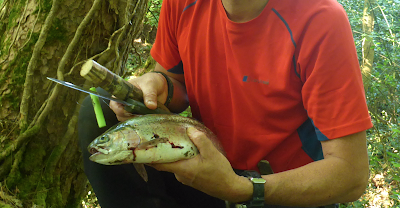
The Extrema Ratio Giant Mamba about to be tested out.
Gutting freshly caught trout, no problems!


Can't do this without a very sharp blade and the knife came with a deadly sharp blade out of the box!


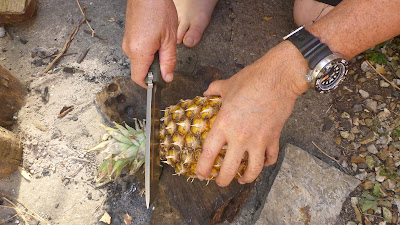
                                          This tasty pineapple lasted about 5 minutes after cutting!

Field Maintenance


Having a simple blade profile means an easy to maintain edge in the field. The Extrema Ratio Giant Mamba can be field stripped for cleaning without the need for any specialized tools. The Giant Mamba is also very easy to wipe clean as it has not extraneous features which can get caught up upon a cleaning rag/cloth.

A note here about "Field Maintenance" This does not mean maintenance conducted on the ground or dirt or hanging over a cliff face! Good field maintenance means working over a clean area and better still over a small mat or plastic sheet to prevent the loss of parts and or tools and to keep the area clean (after all that's why one is conducting maintenance). It means doing all, if not most of the same thing you would do in a dedicated area/room but now forced to do in the field. Finally remembering to work safely as once any knife handle is removed there is no longer a safe sure grip present to hold the blade.


The lanyard hole allows one to insert any rigid object through the hole  to unscrew the pommel and therefore remove the handle to be able to clean the knife tang.


Here I use my Titanium K9 to remove the pommel. But rigid plastic will also do!

The above and below images show how easy it is to remove the pommel via any pointed instrument (anti-clockwise to remove the pommel). Once the pommel is removed (advise performing this task whilst the knife is still in the scabbard-or the blade extracted and the edge is shielded from the user). One can slide the handle off the tang very carefully, removing (do not let it drop-read above!) the small steel nut from within the knife tang, now the blade can be properly washed/cleaned- Reverse process. 
One thing to note here, is that once the handle has been removed the blade can slip out of the scabbard (if you leave it there) through its base or top entrance.  The reason is because the symmetry of Forprene grip at the "hilt" locates the blade centrally within the locking part of the scabbard, and if not present, the blade will shift to one side of the scabbard due to the nature of the "springiness" of the locking system. 


Squeeze the scabbard as indicated in this picture and this will hold securely the knife (metal only) within the scabbard whilst handle is removed prior to and replaced after cleaning.


Just insert and rigid object into the pommel to screw it from the tang bolt


The thread is a separate part to the actual pommel, probably held in place by a permanent Loctite?


The pommel has been machined from a 300 series, low magnetic stainless steel.


The handle, made from the same Forprene material as their other knives, and also sporting that truly full sized ergonomic grip, which if you are not aware, was based upon a collaborative effort from Extrema Ratio and  University scientists**** specialising in biomechanics of the human hand. However, in the case of the Giant Mamba, the handle totally encloses the 6mm thick tang and is held in place via a  "screw in" pommel made from 300 L series stainless steel.

The screw down pommel means tool-less maintenance since any straight rigid object can be used to remove the pommel and thus access the tang for cleaning if the knife was to be submerged in salt or dirty water for prolonged periods.

The Modified Tanto

The Giant Mamba's blade shape is that of a modified Tanto, not only is this an aesthetic design, it is relatively easy to maintain in the field and thus an important choice for the professional on the go.
We see large well-placed finger gimping along the spine for a non slip finger or thumb placement. Let's not forget the aesthetics too. 

Having a long fuller is not only useful for decreasing the knife weight (otherwise this would be one very heavy knife) but can serve another function to release air or liquid if the product is used to penetrate objects.


The Grip 

When I think of Extrema Ratio as a brand, I  think not just about the business end but of their handle design/s. At first glance if one is unfamiliar with them, they may appear unconventional, however any such thoughts soon disappear when you actually take hold of an Extrema Ratio knife. Their grips provide a great combination of tactility, vibration absorption and durable (virtually unbreakable**-short of chopping the grip up with an axe or throwing it into a fire!)


Upper knife, Giant Mamba, showing the smaller cutaway in the Forprene as compared with Extrema Ratio's regular ergonomic grip seen below (lower knife T4000S). Last image showing the underside of the Giant Mamba and the cutaway in the Forprene grip. 
The newer 2020 grip style, in keeping with the general overall shape of the classic ergonomic Extrema Ratio Forprene grip.(Shown here the HCS version)
End view of a Giant Mamba grip showing the inner seat of where the pommel rests against and hence providing adequate friction to keep the pommel attached.


Grip Material

The choice of grip material is the same for the majority of the Extrema Ratio fixed blade product line, ie Forprene.

Forprene  is a TVP- Thermoplastic Vulcanizate  Elastomer (sometimes known as a TPE-Thermoplastic Elastomer)  is a polymer with an amazingly wide range of specifications.** here are listed just a few, applicable for use with the Giant Mamba's handle.


  • Excellent Resistance to UV ageing, Ozone attack and weathering
  • Operating temperature range -40°C-130°C
  • Excellent resistance to deformation by returning to its normal shape, even over a wide temperature range. (also see below re Shore Hardness)
  • Excellent chemical resistance including: aqueous solvents, acids and bases, detergents etc.
  • High fatigue resistance
  • Good abrasion resistance.
  • High Shore hardnesses easily obtained which can provide excellent mechanical properties. This means the grips will not deform under extreme twisting loads.
  • Good at absorbing vibration.

All of the above Forprene qualities make for an excellent choice for a durable field product.


Ok this was just a quick taster for this new Extrema Ratio model for 2020, the Giant Mamba.

Stick around for a full on field review coming soon of the Extrema Ratio Giant Mamba on BushCampingTools!


*A Mamba is a large deadly poisonous  and very fast moving much feared snake,  with a reputation of: "Formidable"! 

**Data taken from  So.F. TER website (since 2016 owned now by Celanese- HQed in Dallas)


**** Through the challenges associated with resolving technical issues, finding an efficient and ergonomic design and optimal operating parameter, the Facoltâ di Scienze Motorie (PG) partnership has provided innovative opportunities through the whole manufacturing process.


*** Whilst the Giant Mamba is a heftily constructed knife, it is not indestructible and is a knife first and foremost, not a pry bar, screwdriver or hammer. Any knife can be broken if undue excessive forces are applied to them.